


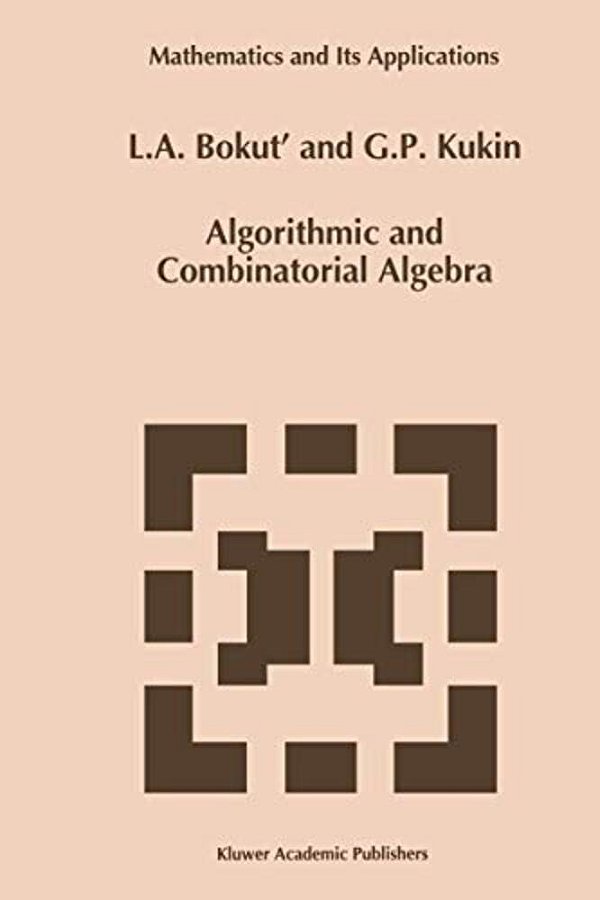
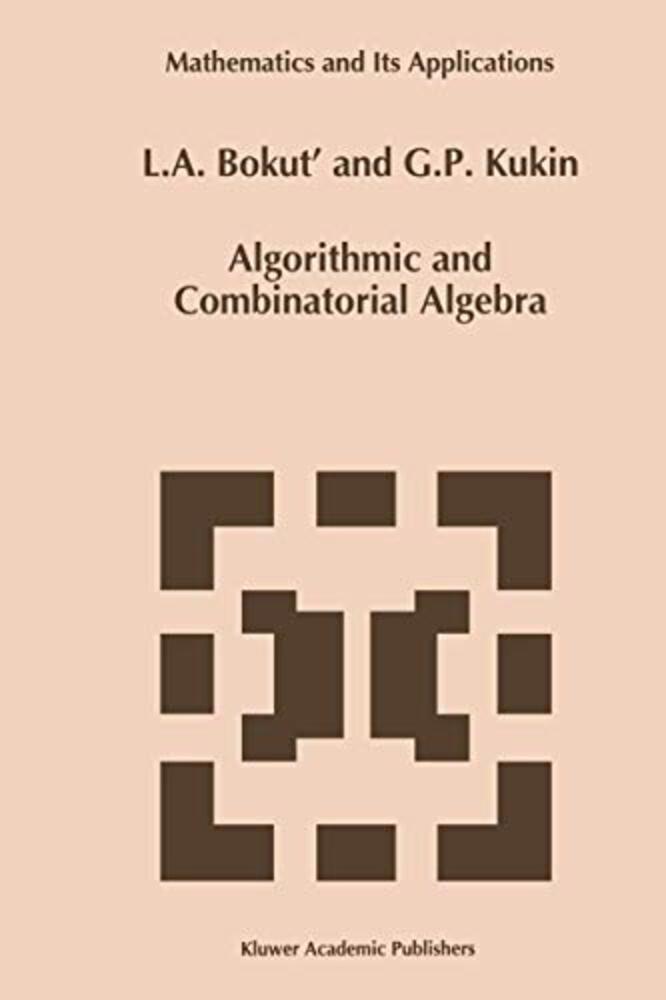
Algorithmic And Combinatorial Algebra-..
-
- 1x de R$ 912,92 sem juros
- 2x de R$ 456,46 sem juros
- 3x de R$ 304,30 sem juros
- 4x de R$ 228,23 sem juros
-
R$ 867,27

-
R$ 912,92


Even three decades ago, the words 'combinatorial algebra' contrasting, for in- stance, the words 'combinatorial topology, ' were not a common designation for some branch of mathematics. The collocation 'combinatorial group theory' seems to ap- pear first as the title of the book by A. Karras, W. Magnus, and D. Solitar [182] and, later on, it served as the title of the book by R. C. Lyndon and P. Schupp [247]. Nowadays, specialists do not question the existence of 'combinatorial algebra' as a special algebraic activity. The activity is distinguished not only by its objects of research (that are effectively given to some extent) but also by its methods (ef- fective to some extent). To be more exact, we could approximately define the term 'combinatorial algebra' for the purposes of this book, as follows: So we call a part of algebra dealing with groups, semi groups, associative algebras, Lie algebras, and other algebraic systems which are given by generators and defining relations {in the first and particular place, free groups, semigroups, algebras, etc. )j a part in which we study universal constructions, viz. free products, lINN-extensions, etc. j and, finally, a part where specific methods such as the Composition Method (in other words, the Diamond Lemma, see [49]) are applied. Surely, the above explanation is far from covering the full scope of the term (compare the prefaces to the books mentioned above).
| ISBN | 9780792323136 |
| Autor(a) | Bokut', L. A. |
| Editora | Springer Publishing |
| Ano de edição | 1994 |
| Páginas | 384 |
| Acabamento | Capa Dura |
Produtos relacionados
-
 Fundamental Problems Of Algorithmic Algebra-..R$ 2.431,82até 4x de R$ 607,95 sem jurosou R$ 2.310,23 via Pix
-


Categorias
Conteúdo
Sobre a loja
Myre Livraria, sua livraria online especializada em importação e revenda de livros nacionais e internacionais. Oferecemos uma vasta seleção de materiais didáticos de alta qualidade para aprender inglês, espanhol, francês, alemão e muito mais. Aproveite preços competitivos e entrega rápida em todo o Brasil
Pague com

Selos

Myre Editora Ltda. - CNPJ: 50.295.718/0001-20 © Todos os direitos reservados. 2026
