


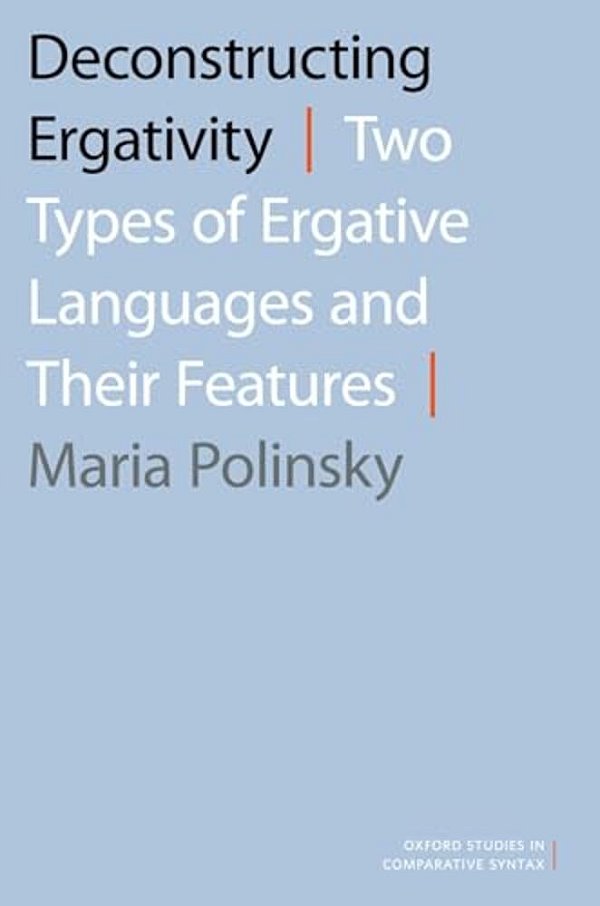
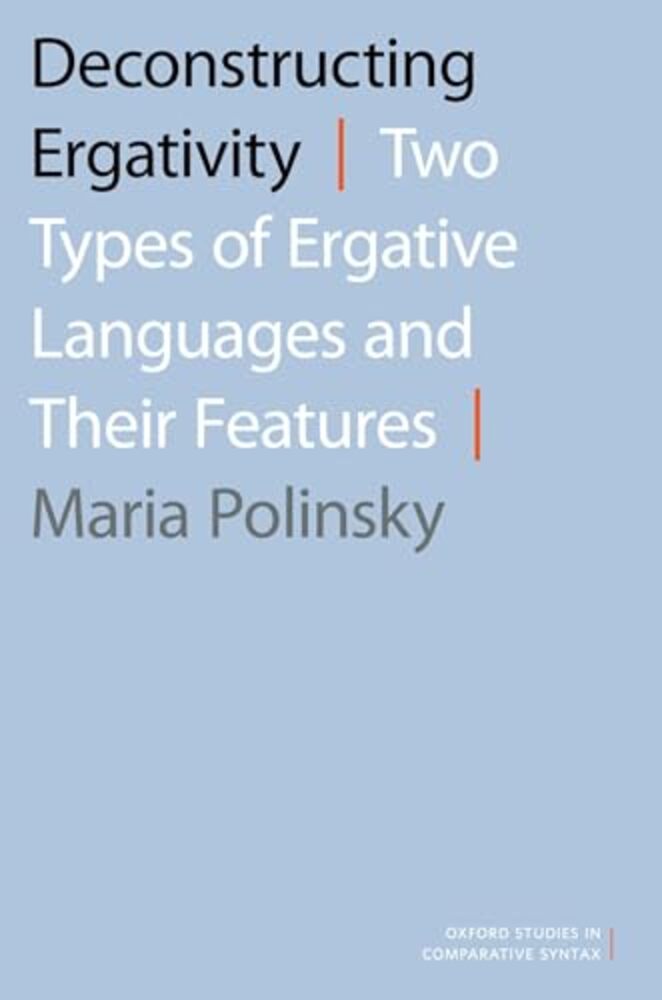
Deconstructing Ergativity: Two Types Of Ergative Languages And Their Features-..
-
- 1x de R$ 506,30 sem juros
- 2x de R$ 253,15 sem juros
- 3x de R$ 168,76 sem juros
- 4x de R$ 126,57 sem juros
-
R$ 480,98

-
R$ 506,30


Nominative-accusative and ergative are two common alignment types found across languages. In the former type, the subject of an intransitive verb and the subject of a transitive verb are expressed the same way, and differently from the object of a transitive. In ergative languages, the subject of an intransitive and the object of a transitive appear in the same form, the absolutive, and the transitive subject has a special, ergative, form. Ergative languages often follow very different patterns, thus evading a uniform description and analysis. A simple explanation for that has to do with the idea that ergative languages, much as their nominative-accusative counterparts, do not form a uniform class. In this book, Maria Polinsky argues that ergative languages instantiate two main types, the one where the ergative subject is a prepositional phrase (PP-ergatives) and the one with a noun-phrase ergative. Each type is internally consistent and is characterized by a set of well-defined properties. The book begins with an analysis of syntactic ergativity, which as Polinsky argues, is a manifestation of the PP-ergative type. Polinsky discusses diagnostic properties that define PPs in general and then goes to show that a subset of ergative expressions fit the profile of PPs. Several alternative analyses have been proposed to account for syntactic ergativity; the book presents and outlines these analyses and offers further considerations in support of the PP-ergativity approach. The book then discusses the second type, DP-ergative languages, and traces the diachronic connection between the two types. The book includes two chapters illustrating paradigm PP-ergative and DP-ergative languages: Tongan and Tsez. The data used in these descriptions come from Polinsky's original fieldwork hence presenting new empirical facts from both languages.
| ISBN | 9780190256593 |
| Autor(a) | Polinsky, Maria |
| Editora | Oxford University Press - USA |
| Ano de edição | 2016 |
| Páginas | 410 |
| Acabamento | Brochura |
| Dimensões | 23,40 X 15,50 |
Produtos relacionados

Categorias
Conteúdo
Sobre a loja
Myre Livraria, sua livraria online especializada em importação e revenda de livros nacionais e internacionais. Oferecemos uma vasta seleção de materiais didáticos de alta qualidade para aprender inglês, espanhol, francês, alemão e muito mais. Aproveite preços competitivos e entrega rápida em todo o Brasil
Pague com

Selos

Myre Editora Ltda. - CNPJ: 50.295.718/0001-20 © Todos os direitos reservados. 2026
